

Open source · Local by default
Zeraix
Local AI, engineered from
workspace to runtime.
An open-source desktop workspace for running private local models, tools, files, and AI agents on your own computer.
No account. No subscription. No API key for the local core.
02 Local first
Built the other
way around.
Most AI workspaces are designed around cloud APIs, with local models added as a secondary option. In Zeraix the local model is the centre — and the cloud is the thing you opt into.
- Free local core
- No account, subscription or usage quota
- Private by default
- Prompts, conversations and files stay on device
- Offline after setup
- Local features run without cloud services
- Bring your own model
- Local models, or any compatible endpoint
03 Workspace
One application,
not five tabs.
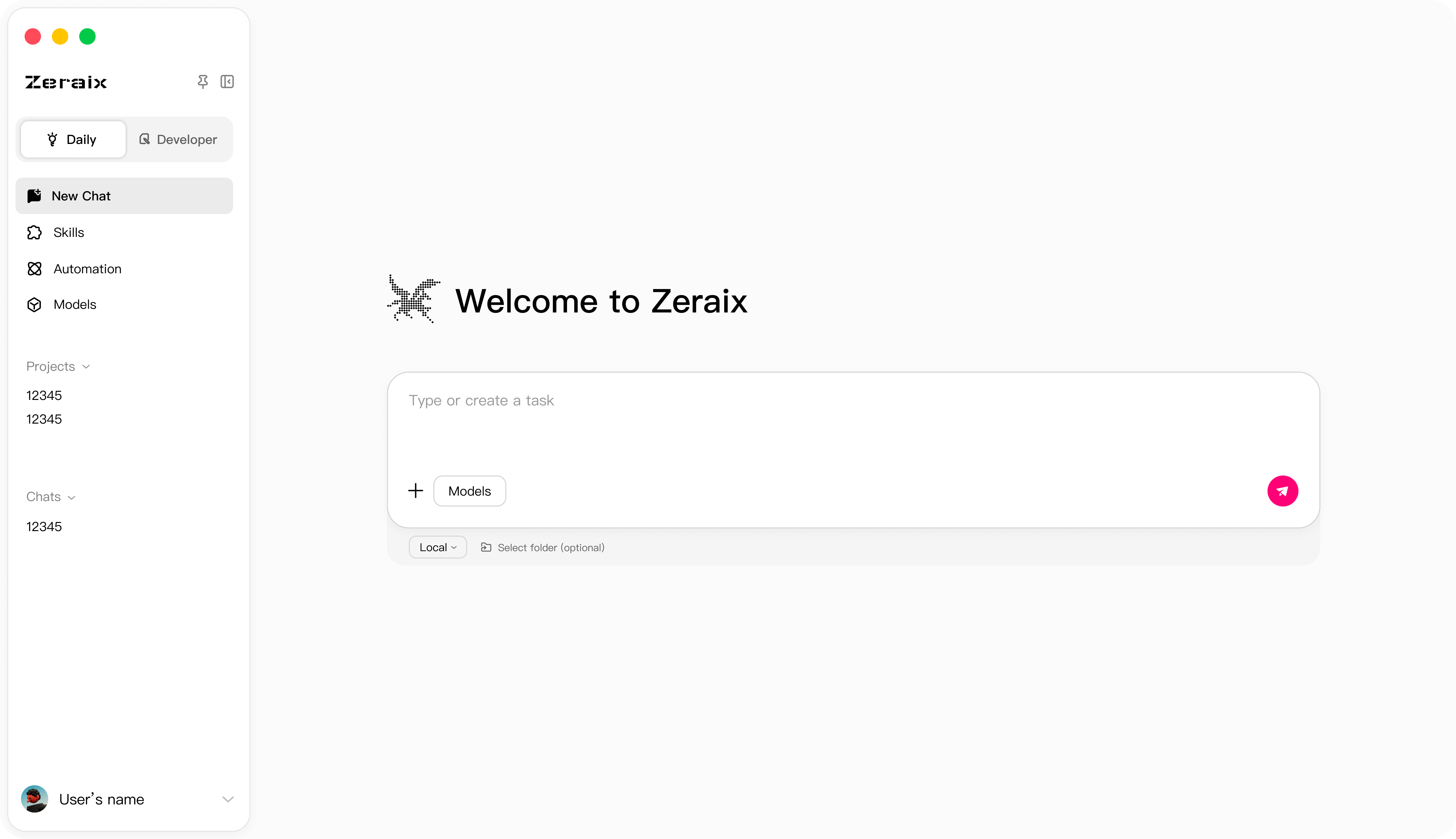
Conversations, memory, files, terminal, Skills, sub-agents and schedules — all in one desktop application, all running on your machine.
- Daily
- Developer
- Skills
- Automation
- Models
- MCP
04 Models
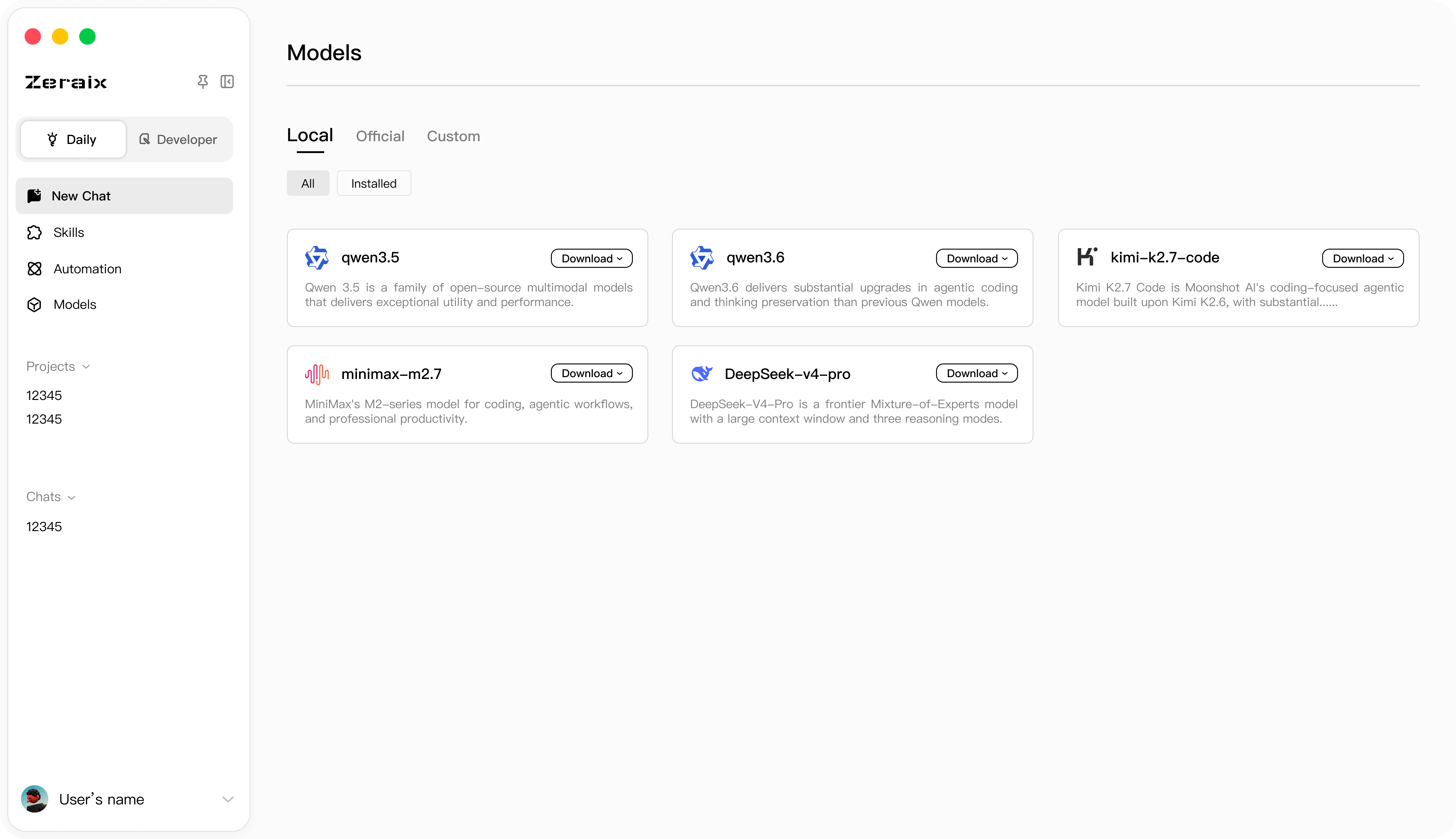
It reads your machine
before it picks.
Zeraix inspects the memory and GPU it has to work with, then recommends a model it can actually sustain — with the estimates shown before anything downloads.
- 01 Inspect
- 02 Recommend
- 03 Estimate
- 04 Run
05 Developer mode
Give it a directory,
keep the veto.
Every capability that can change your machine is paired with a control that lets you stop it.
Capability
- Read and search files
- Create and edit files
- Run terminal commands
- Delegate to sub-agents
Control
- Scoped to your directory
- Diffs shown before applying
- Commands need approval
- Sandbox status made visible
06 Imparo · model systems
An engine that refuses
to claim what it cannot prove.
An independent, state-native inference runtime — not a wrapper around another engine. Nothing is promoted as “an optimization”. It is promoted as a cell, and a cell is only a cell when all six parts are bound to it.
phase program
The bounded unit a backend actually owns.
state transition
Exactly what it does to generational state.
applicability domain
The model, hardware and workload it may claim.
resource contract
What it may consume before it is stopped.
evidence receipt
The reproducible record that cleared the gate.
verified fallback
The path taken when it does not apply.
07 Evidence
Backends propose.
The runtime publishes.
Native backends return candidate state; only the runtime commits it. Unqualified programs never reach the production registry, and anything unsupported fails closed before it touches the device.
Research is labelled research. It becomes a product capability when the qualification artifact exists — not before.
- CandidateBackend returns state + telemetry
- GateCorrectness · resource · applicability
- PromoteMonotonic generation, evidence bound
- Or fall backVerified path, fail closed
08 Install
Runs on hardware
you already own.
macOS on Apple Silicon, or Windows 10/11 on x64. More memory means larger models and longer contexts.
 Join us on Discord
  Follow us on X